

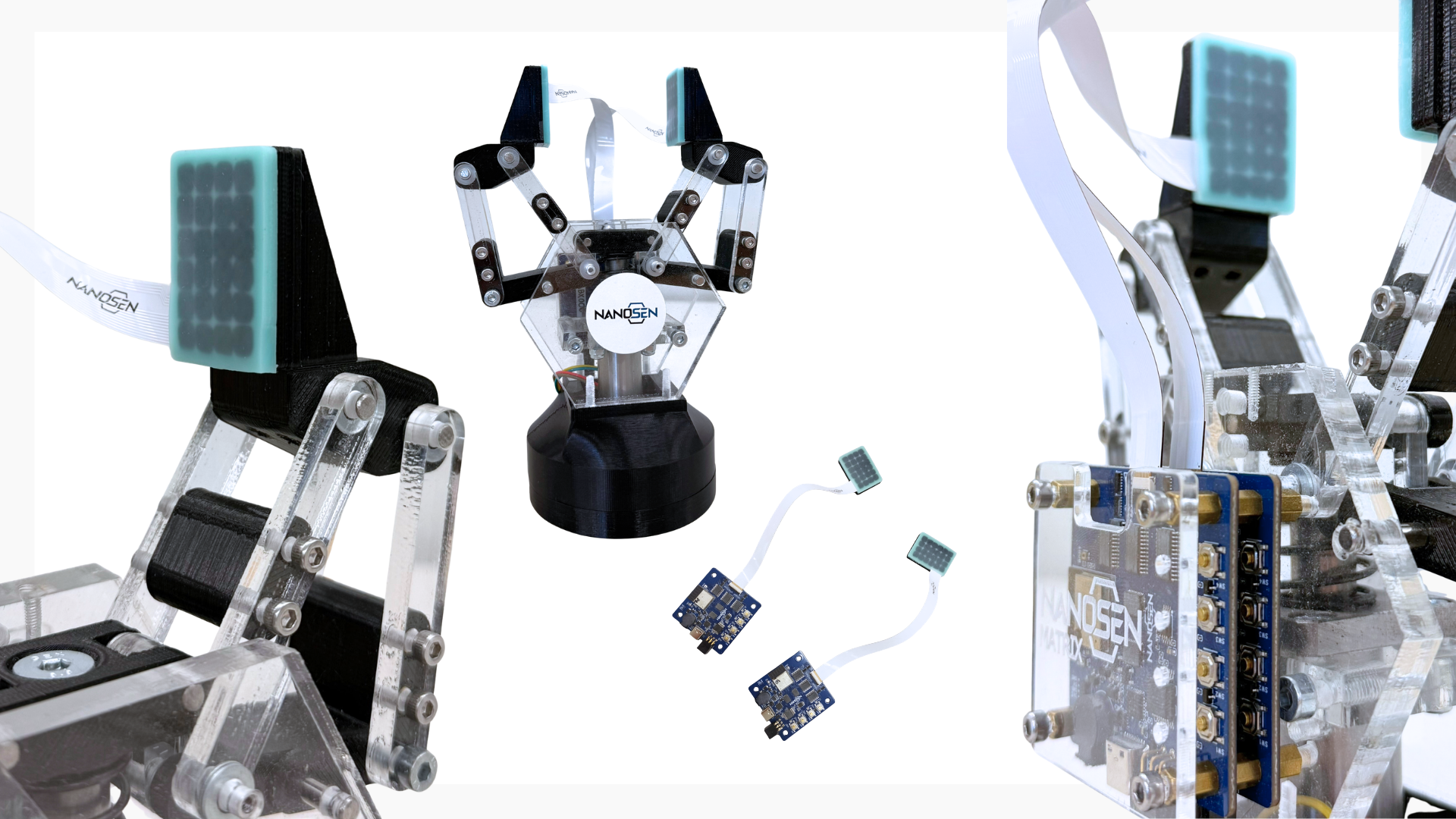
Innovation rarely follows a straight path. Our force sensor matrix is the result of years of development, countless design iterations, and one critical technical breakthrough. What started as an early concept for measuring force distribution eventually evolved into a miniaturized sensing platform for robotic grippers, and it continues to evolve today. This is the story behind our force sensor matrix.
Where It All Started
More than two years ago, we began exploring the idea of combining multiple PNC force sensors into a single sensing matrix. Instead of measuring force at one point, we wanted to capture an entire contact surface. A matrix would make it possible to visualize force distribution, detect multiple contact points simultaneously, and enable entirely new sensing capabilities for robotics, research, and human-machine interaction. The first concepts looked promising. But there was one major challenge.
The Crosstalk Problem
Like many matrix-based sensing systems, our early prototypes suffered from crosstalk. Signals from neighboring sensor elements influenced one another, making it difficult to accurately determine where force was actually being applied. For applications requiring reliable and repeatable measurements, this simply wasn’t good enough. Rather than releasing a solution that didn’t meet our standards, we decided to pause the project and focus on other developments while continuing to investigate the problem. Sometimes, the hardest part of engineering is knowing when a technology isn’t ready yet.
The Breakthrough
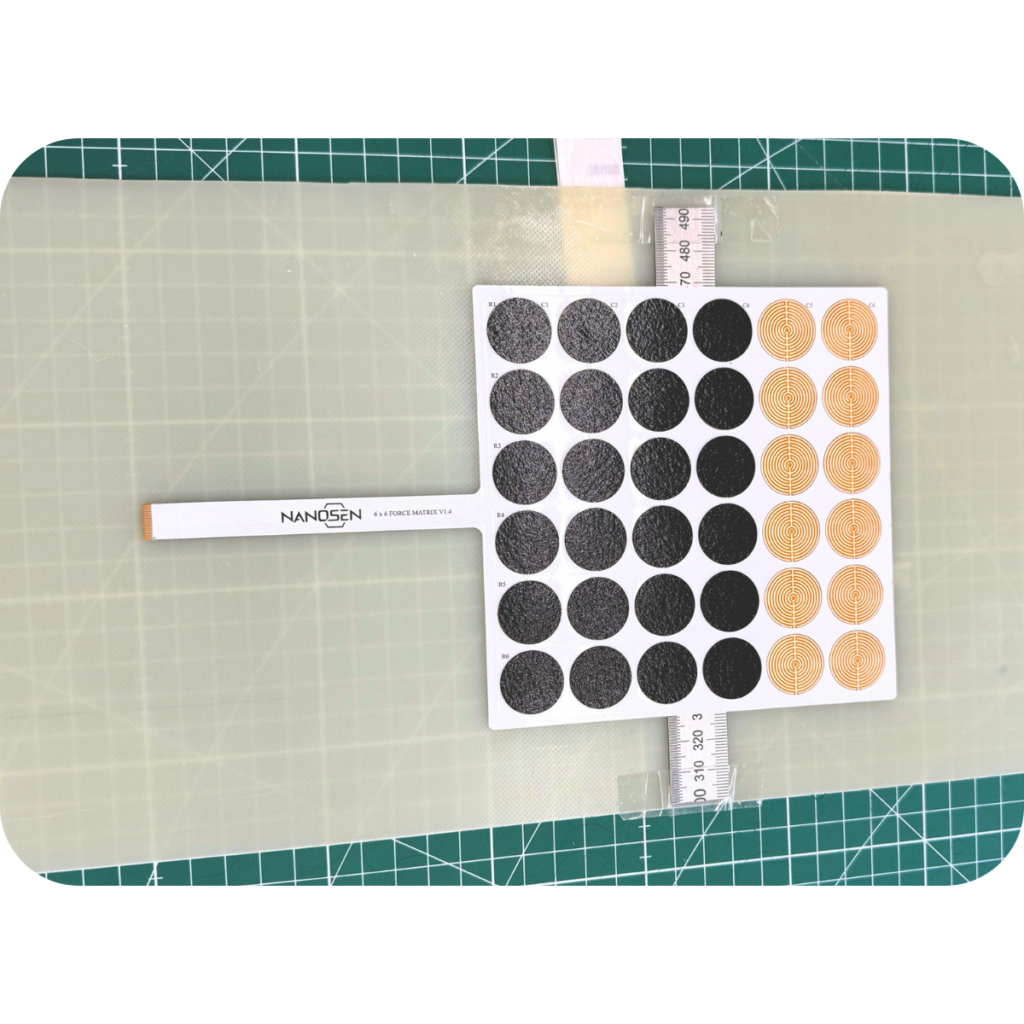
Everything changed when we found a solution for active crosstalk elimination last year. By combining our PNC materials with newly developed readout electronics and proprietary Force Sensing Impedance (FSI) technology, we were finally able to isolate individual sensing elements and obtain stable, repeatable measurements across the entire matrix. This breakthrough transformed the project from an interesting concept into a practical sensing platform. For us, this was the moment when the matrix truly became possible.
From Prototype to Force Matrix Kit
Once the first matrix prototypes delivered reliable results, development accelerated quickly. We designed what is now our Force Matrix Kit: a complete development kit that combines flexible force sensing with advanced electronics featuring active crosstalk elimination.
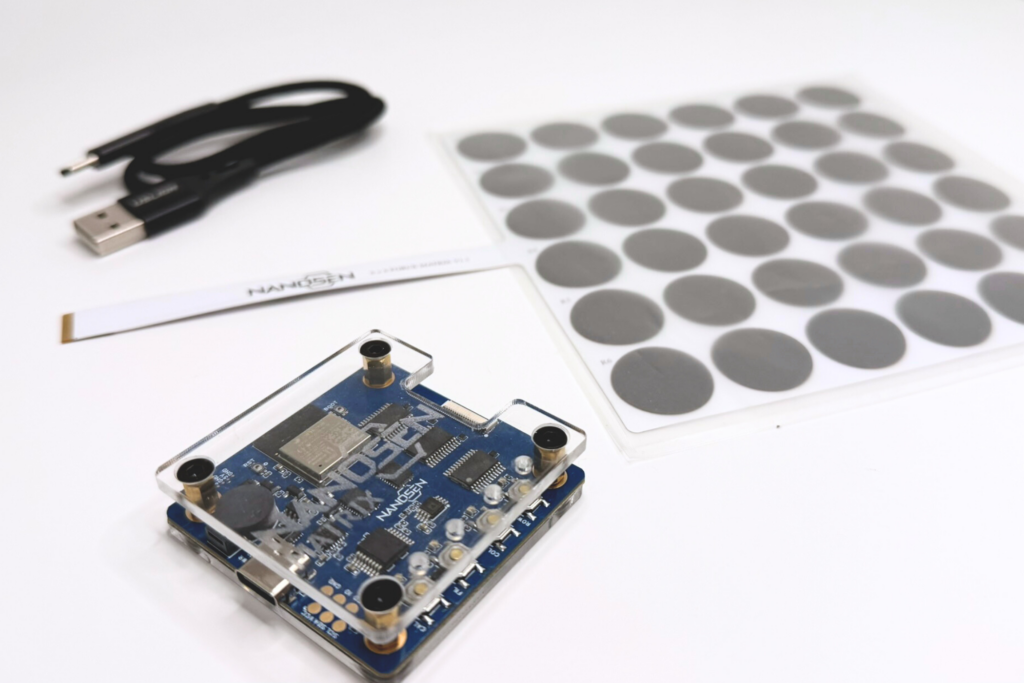
The current kit includes:
- A 6 × 6 sensor matrix with 36 force sensors (Support for matrices with up to 100 sensors)
- USB-C connectivity and power supply
- I2C communication support, Bluetooth connectivity
- Advanced readout electronics optimized for Force Sensing Impedance technology
Rather than serving as a finished application, the kit provides engineers and researchers with a platform for developing and evaluating matrix-based force sensing concepts.
Exploring New Matrix Designs
With a reliable platform available, we began experimenting with new layouts, geometries, and applications. Some prototypes focused on optimizing sensor arrangements, while others explored different matrix sizes and interaction concepts.
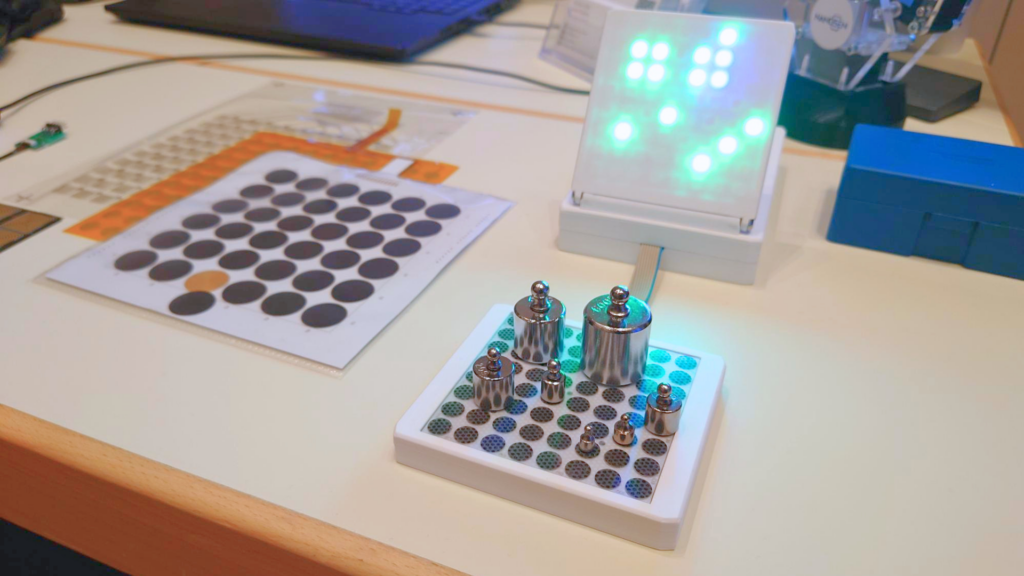
One particularly demonstrator became our small LED Matrix demonstrator, showing just how responsive and interactive a flexible force sensor matrix could be. Although created as a technology demonstrator, projects like these helped us better understand user interaction and inspired future developments.
Bringing Force Distribution to Robotic Grippers
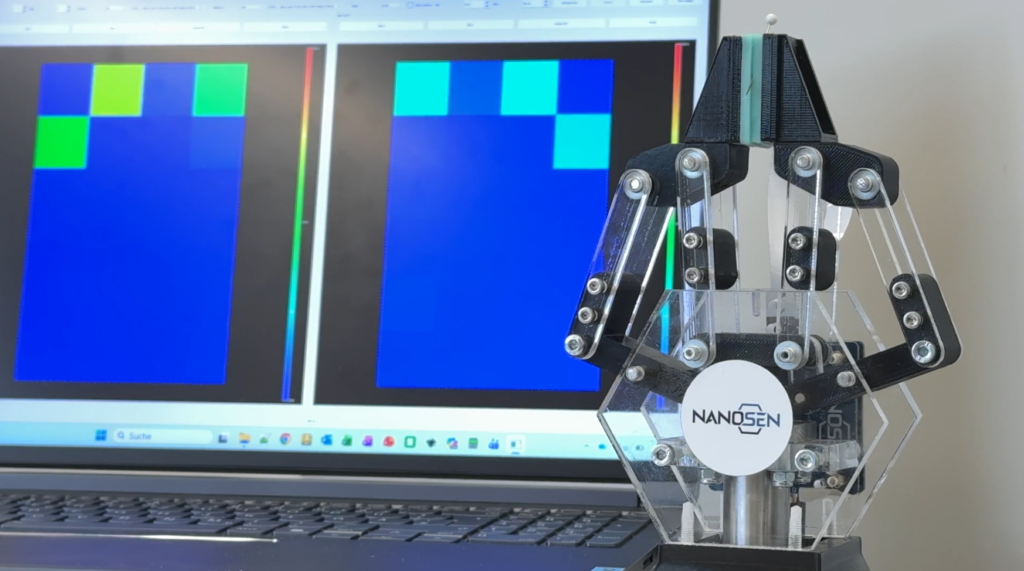
As robotics applications became increasingly important, we began asking a new question: What if the matrix could become small enough to fit inside a robotic gripper? For our collaboration with Sarcomere Dynamics, we developed our first miniaturized gripper matrix featuring 4 × 6 sensing elements, each with a square of just 4 mm. Despite its compact size, the matrix provided detailed force distribution information directly at the gripping surface.
One demonstration especially at the beginning of developing the Matrix Gripper surprised us. By analyzing the pressure distribution across the matrix, we were able to determine the position of a thin needle placed between the gripper fingers of our NanoSen Gripper Demonstrator.
From Force Distribution to Slip Detection
The next step was to use the matrix for intelligent gripping.
By continuously monitoring how force is distributed across the contact surface, the robotic gripper can detect when an object begins to move or slip. Instead of relying only on the overall gripping force, the system recognizes subtle changes in the contact pattern and reacts before the object is lost.
This allows the robot to automatically adjust its grip in real time, applying additional force only when necessary. The result is a more adaptive and reliable gripping process that can securely handle objects with varying shapes and surface properties.
We demonstrated this capability live during the Hannover Messe together with Sarcomere Dynamics, where visitors could observe the gripper responding dynamically as objects began to slip. Rather than maintaining a constant gripping force, the system continuously adapted its grip based on the measured force distribution – showcasing the potential of matrix-based tactile sensing for next-generation robotic manipulation.
Looking Toward Humanoid Robotics
Today, flexible force sensor matrices are becoming increasingly relevant for advanced robotic hands and humanoid robots. Naturally, these applications have also found their way into our workshop. We’re continuously exploring new matrix geometries, smaller sensing elements, and more sophisticated integration concepts to support the next generation of robotic manipulation. The journey that started with a simple matrix concept is still ongoing, and we’re excited to see where it leads next.
Looking back, our force sensor matrix wasn’t developed in a single breakthrough. It evolved through years of experimentation, setbacks, engineering challenges, and continuous refinement. From early concepts and solving crosstalk to miniaturized gripper matrices with slip detection, every step has brought us closer to enabling more intelligent, adaptive robotic systems. And we’re only getting started.
Ready to Explore the Technology?
Whether you want to evaluate flexible force sensing in your own lab or accelerate your next robotics project, the PNC Force Matrix Kit is the ideal place to start.
→ NanoSen | Force Matrix Kit – High-Precision Force Sensing Matrix
Looking for a custom gripper matrix or an application-specific sensing solution?
Our engineering team works closely with customers to develop force sensor matrices tailored to their application, from concept and prototyping to fully integrated robotic systems.
→ Get in touch to discuss your project
Learn more about our technology: NanoSen | Cutting-Edge PNC Force Sensing Technology

No responses yet