

Collaborative robots (cobots) are transforming modern manufacturing, logistics, healthcare, and research by enabling safe interaction between humans and machines. Unlike traditional industrial robots, cobots are designed to operate in shared workspaces, making accurate force sensing a key component of both safety and performance.
Whether a cobot is gripping delicate components, assisting an operator, or performing quality inspections, its ability to detect and respond to external forces directly influences its effectiveness. However, selecting the right force sensing technology is not always straightforward. Different sensor principles offer different strengths, and the optimal solution depends on the application’s specific requirements.
This article compares the most common force sensing technologies used in collaborative robotics and highlights the factors engineers should consider when selecting a sensing solution.
Key Requirements for Cobot Force Sensors
Selecting a force sensor involves balancing multiple technical requirements. The importance of each criterion depends on the application, but several factors are consistently relevant in collaborative robotics.
Sensitivity and Accuracy
Cobots often handle objects with varying stiffness, weight, and fragility. High sensitivity enables reliable detection of both small contact forces and larger mechanical loads while maintaining precise control.
Mechanical Flexibility
Many robotic end effectors feature curved or compact geometries that leave limited installation space. Flexible sensing solutions can simplify integration and allow force measurement across surfaces that are difficult to instrument with rigid sensors.
Integration Space
Compact sensor designs help reduce system complexity and enable force sensing in applications where conventional sensors would be difficult to accommodate.
Stability and Repeatability
Reliable long-term performance is essential for industrial automation. Sensor technologies should provide stable measurements over extended operating periods while minimizing drift and maintaining consistent signal quality.
Safety
Low-latency force detection supports rapid system response during unintended contact events, contributing to safer human-robot collaboration.
Comparison of Common Force Sensing Technologies
Several sensing principles are widely used in robotics, each offering unique advantages depending on the application.
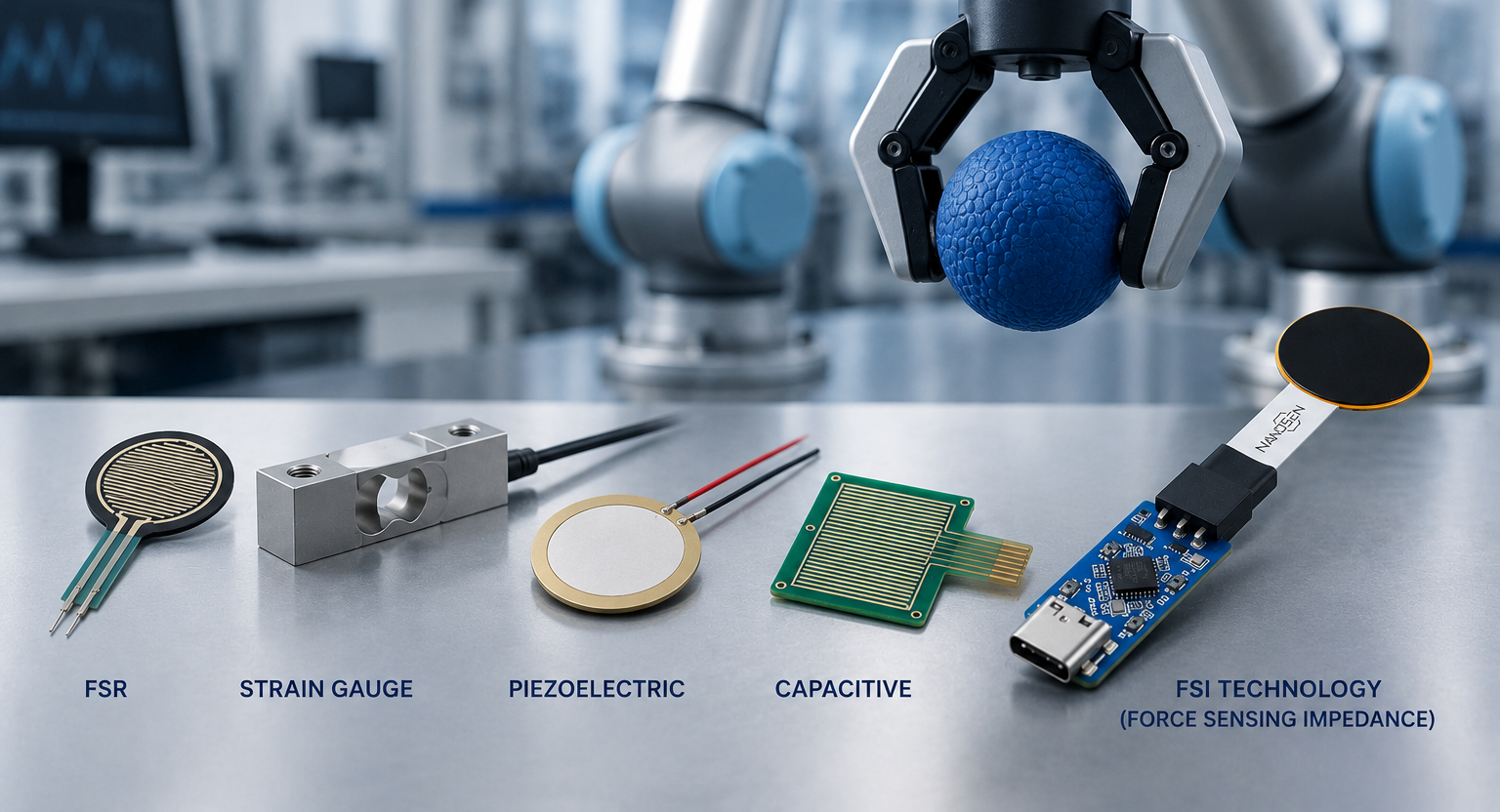
| Technology | Flexibility | Typical Strengths | Limitations |
|---|---|---|---|
| Force Sensing Resistor | High | Thin, flexible, cost-effective, easy to integrate | Hysteresis, drift, reduced repeatability, mainly suited for touch detection rather than precise force measurement |
| Strain Gauge | Low | High accuracy, mature technology, ideal for load cells | Rigid construction, limited design flexibility |
| Piezoelectric | Low | Excellent for dynamic force measurement and vibration detection | Cannot measure static forces |
| Capacitive | Moderate | High sensitivity, suitable for touch and proximity sensing | Sensitive to environmental influences and parasitic capacitance |
| Force Sensing Impedance Technology (FSI) | High | Flexible, application-specific, stable, repeatable, system-level sensing | Requires dedicated impedance-based readout electronics |
Each technology addresses different engineering challenges. Rather than searching for a universally “best” sensor, engineers should evaluate which sensing principle aligns with their mechanical, electrical, and performance requirements.
How Force Sensing Impedance (FSI) Technology Addresses Modern Cobot Requirements
NanoSen’s proprietary Force Sensing Impedance (FSI) technology takes a system-level approach to force measurement by combining advanced PNC materials with dedicated impedance-based signal acquisition.
Unlike conventional sensing approaches, the PNC material alone does not provide reliable force sensing. Accurate and repeatable measurements are achieved through the interaction between the material and NanoSen’s proprietary readout technology.
This approach enables application-specific force sensing solutions that can be optimized for:
- Flexible sensor geometries
- Compact system integration
- Stable and repeatable measurements
- High sensitivity
- Long-term reliability
- Custom mechanical and electrical requirements
Because every application presents different challenges, NanoSen also supports customers with development services ranging from concept evaluation and feasibility studies to material adaptation, prototype development, validation, and system integration.
Rather than adapting an application to a predefined sensor, Force Sensing Impedance (FSI) technology allows the sensing solution to be developed around the application’s specific requirements.
Conclusion
There is no single force sensing technology that is ideal for every collaborative robot.
Strain gauges, Force Sensing Resistors, piezoelectric sensors, capacitive sensors, and Force Sensing Impedance (FSI) technology each offer distinct advantages depending on the application, integration constraints, and performance objectives.
As cobots continue to evolve toward more compact, adaptive, and intelligent systems, flexible and application-specific sensing solutions are becoming increasingly important. By considering not only measurement performance but also integration, stability, and long-term reliability, engineers can select the force sensing technology best suited to their design.
For applications requiring customized, flexible force sensing, NanoSen’s Force Sensing Impedance (FSI) technology provides an innovative alternative that combines advanced polymer nanocomposite materials with proprietary impedance-based measurement to enable reliable, application-specific sensing solutions.
Interested in more applications? Check out the different applications here.

No responses yet