

Smart Materials. Smarter Sensing.
Discover how NanoSen’s polymer nanocomposite (PNC) material and impedance-based force sensing technology convert mechanical force into reliable electrical data. Our sensors are ultra-thin, flexible, and designed for real-world applications.
At NanoSen, we develop next-generation force sensing materials based on polymer nanocomposites (PNC) – a functional combination of flexible polymers and conductive nanoparticles engineered for precise force measurement. This unique material structure allows our thin-film sensors to detect changes in force, pressure, compression, and touch with high precision. When combined with our proprietary readout electronics, the system forms a powerful and adaptable platform for smart sensing solutions across many industries.
How it works
NanoSen’s PNC sensing material consists of a medical-grade flexible polymer matrix embedded with conductive nanoparticles.
The material is manufactured in large sheets, which makes it highly versatile. Thanks to its mechanical flexibility and ultra-thin form factor, it can be easily integrated into both flat and curved surfaces. Individual sensors can
be cut from these sheets using simple mechanical tools, allowing customized sensor shapes and sizes for specific applications. When the PNC sensing layer is combined with contact electrodes and NanoSen’s proprietary readout electronics,
it forms the basis of a scalable impedance-based force sensing system. When mechanical force is applied to the PNC layer, the electrical impedance of the material changes. This change is measured by the electronics and translated
into sensor data.
The result is a stable, repeatable signal that directly correlates with the applied force.
Key Advantages of NanoSen’s PNC Sensors
Compared with traditional force sensing technologies, NanoSen’s PNC sensors offer several advantages:
Key Advantages
Flexibility
Ultra-thin and bendable — adapts seamlessly to curved, wearable, or compact designs.
Durability
Resistant to stress and fatigue — built for long-term stability and performance.
Sensitivity
Capable of resolving subtle force changes across a wide measurement range.
Adaptability
Customizable geometry and easy integration with USB or I²C communication.
From Material to System
NanoSen’s technology is not limited to individual sensor elements.
The system-level approach supports both single-point force measurement and force distribution sensing, allowing scalable sensor architectures based on the same material and measurement principle. This makes the technology suitable
for rapid prototyping as well as application-specific system development.
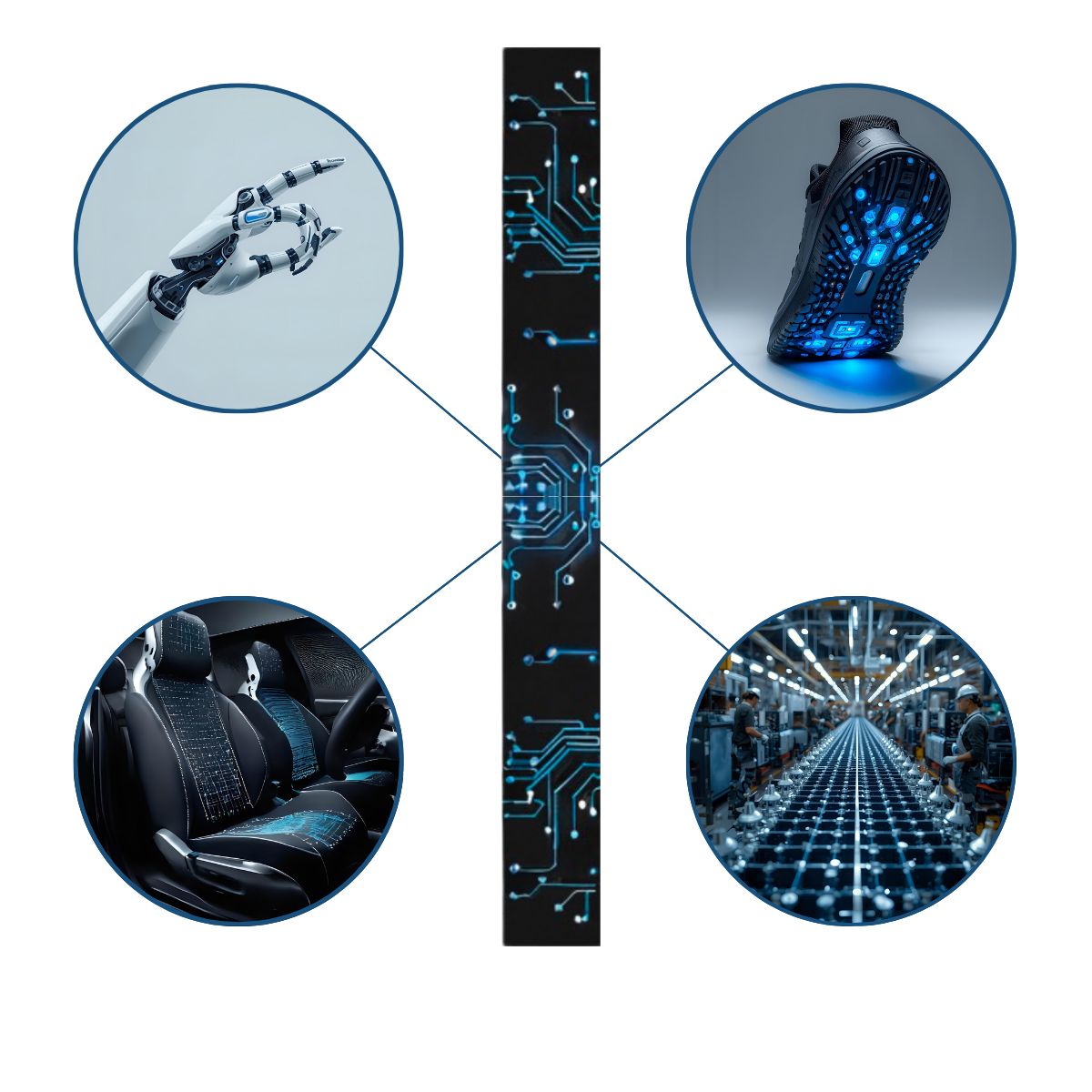
Where Our Technology Comes to Life
NanoSen’s force sensing impedance technology enables reliable force measurement in applications where precision, flexibility, and long-term stability are essential.
It is used in areas such as:
- Force distribution measurement
- Tactile interaction and feedback
- Material characterization and load testing
- Prototyping and system integration
Wherever accurate force data must be captured under real-world conditions, the combination of PNC materials and force sensing impedance measurement provides a robust foundation.
Development Support for Application-Specific Solutions
Not every sensing challenge can be addressed with standard components alone.
NanoSen supports customers with application-specific and
custom sensor development – from initial idea to functional prototype.
This includes adapting material layouts, sensor geometries, and system configurations to meet specific technical requirements.
Frequently Asked Questions
It is made from a polymer nanocomposite (PNC), combining a medical-grade polymer with conductive nanoparticles.
The material is produced as sheets with minimum dimensions of 15 cm x 15 cm and maximum dimensions of 45 cm x 40 cm.
Yes, individual sensor pieces can be easily cut from the sheets and paired with a suitable electrode to create customized force sensors.
NanoSen specializes in large-scale manufacturing of force sensing materials, offers customized sensor designs and scalable solutions, and provides expert support from product selection to implementation.
Didn’t find what you were looking for?
Check out our full FAQ section.
See It in Action
Experience our PNC technology in motion:
Watch the videos below to see the flexibility, sensitivity, and robustness of our sensors.
Introduction
This short explainer video introduces Polymer Nanocomposite (PNC) technology, highlighting its composition, properties, and advantages in force sensing.
Sensor Kit Unboxing
Hands-on demonstrations showcasing the PNC force sensing material in action. This video shows real-time measurements of force applied to the material and visualizations of data output.
PNC Properties – Robustness
A series of short clips demonstrating the robustness of our PNC material with dynamic and static load tests as well as a demonstration of its overload resistance.
