

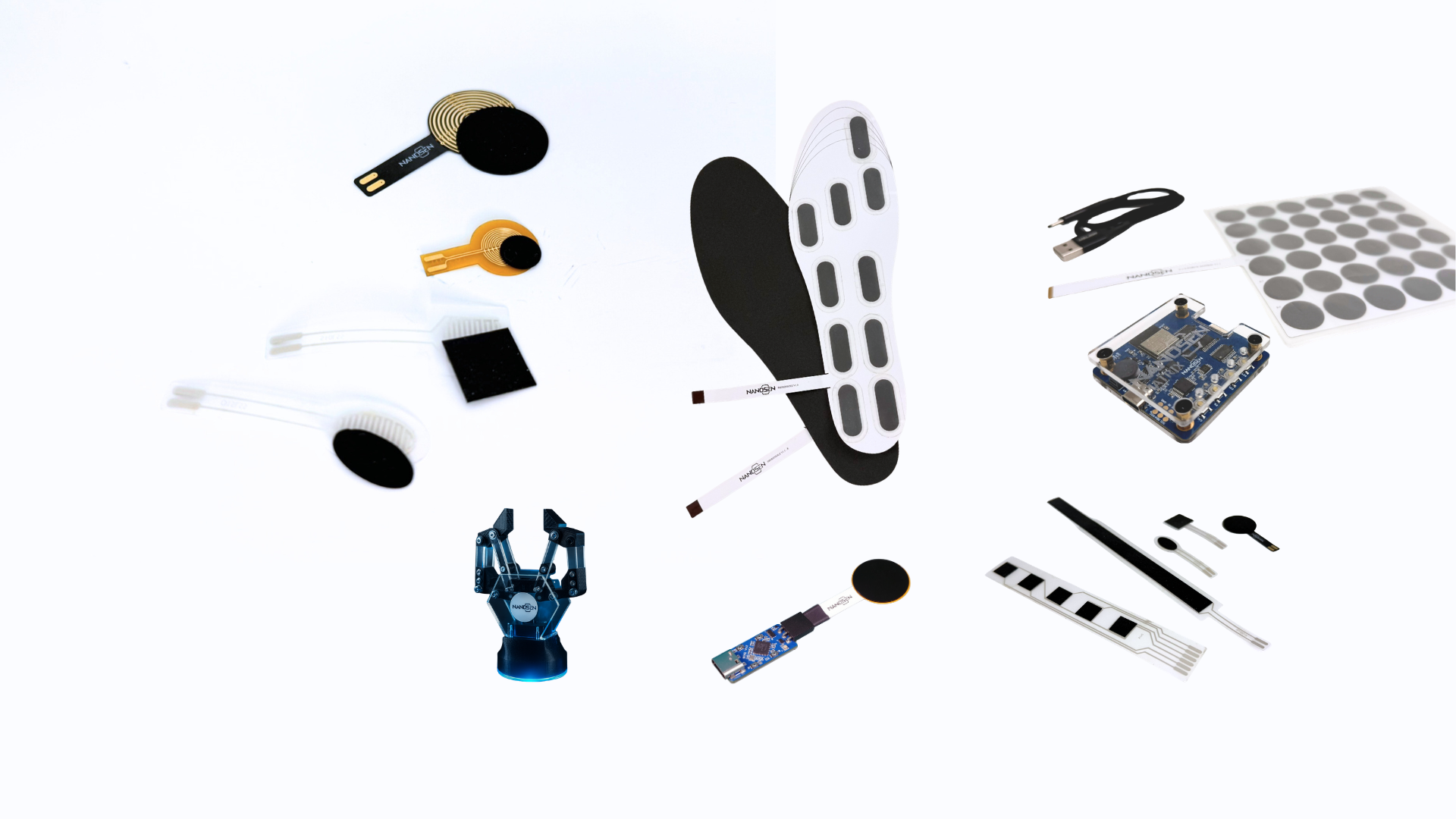
The best sensor is rarely an off-the-shelf sensor.
Modern products are becoming smaller, smarter, and more specialized. Yet many engineers are expected to solve unique measurement challenges using standardized sensing components that were never designed for their application.
Whether it is a robotic gripper, a medical device, a research platform, or an industrial system, force sensing requirements vary significantly. Mechanical constraints, available space, environmental conditions, and performance expectations can differ from project to project.
At NanoSen, we take a different approach. We develop force sensing solutions around the application itself – combining advanced PNC materials with patented Force Sensing Impedance (FSI) technology to create sensing systems tailored to specific performance and integration requirements.
Why Application-Specific Force Sensing Matters
Many force sensing projects begin with a standard sensor. While this may be sufficient for some applications, it often introduces compromises in performance, integration, or reliability.
The challenge is that force sensing is rarely determined by a single parameter. Sensor geometry, material behavior, measurement electronics, environmental influences, and system integration all interact with one another. Achieving reliable results therefore requires a sensing solution that is designed as a complete system rather than a standalone component.

From Requirements to Feasibility
Every development project starts with understanding the application.
NanoSen supports customers in evaluating force sensing requirements and assessing technical feasibility.
During this phase, we work together to define:
- Measurement objectives and force ranges
- Mechanical and spatial constraints
- Environmental requirements
- Integration considerations
- Performance targets and validation criteria
The goal is to identify the most suitable sensing concept before development begins.
Material and Geometry Adaptation
No two applications are identical. Depending on the project requirements, PNC materials, electrode layouts and sensor geometries can be adapted to match specific mechanical and spatial constraints.
This flexibility enables sensing concepts that can be integrated into applications where conventional sensor formats may not be practical. Rather than forcing the application to fit the sensor, the sensing solution is developed around the application.
A System-Level Approach to Force Sensing
One of the key differences of NanoSen’s technology is that sensing performance is achieved through the combination of material and electronics.
The PNC material alone does not function as a complete force sensor. Reliable and repeatable measurements are enabled through NanoSen’s proprietary Force Sensing Impedance (FSI) technology, which combines advanced material design with dedicated impedance-based signal acquisition.
This system-level approach allows optimization of:
- Measurement stability
- 敏感性
- Signal quality
- Long-term reliability
- Application-specific performance requirements
Prototyping, Validation, and Integration
NanoSen supports customers throughout prototyping, validation, and integration activities to ensure that sensing solutions perform under realistic operating conditions.
Depending on project requirements, support can include:
Prototyping and Validation: Development of functional prototypes and iterative testing to verify performance under application-relevant conditions.
Integration Support: Assistance with mechanical integration, interface selection, signal evaluation, and measurement setup.
Application-Specific Optimization: Optimization of sensing performance for stability, sensitivity, robustness, and long-term operation.
与工程团队紧密合作
NanoSen works closely with customer engineering and research teams throughout the development process. Depending on the project stage, support can range from targeted technical consulting to comprehensive development partnerships. Our goal is to enable reliable, functional force sensing solutions that perform under real-world application conditions.
If your application requires more than a standard sensor, we are ready to help develop a solution tailored to your specific requirements.

尚无回复