

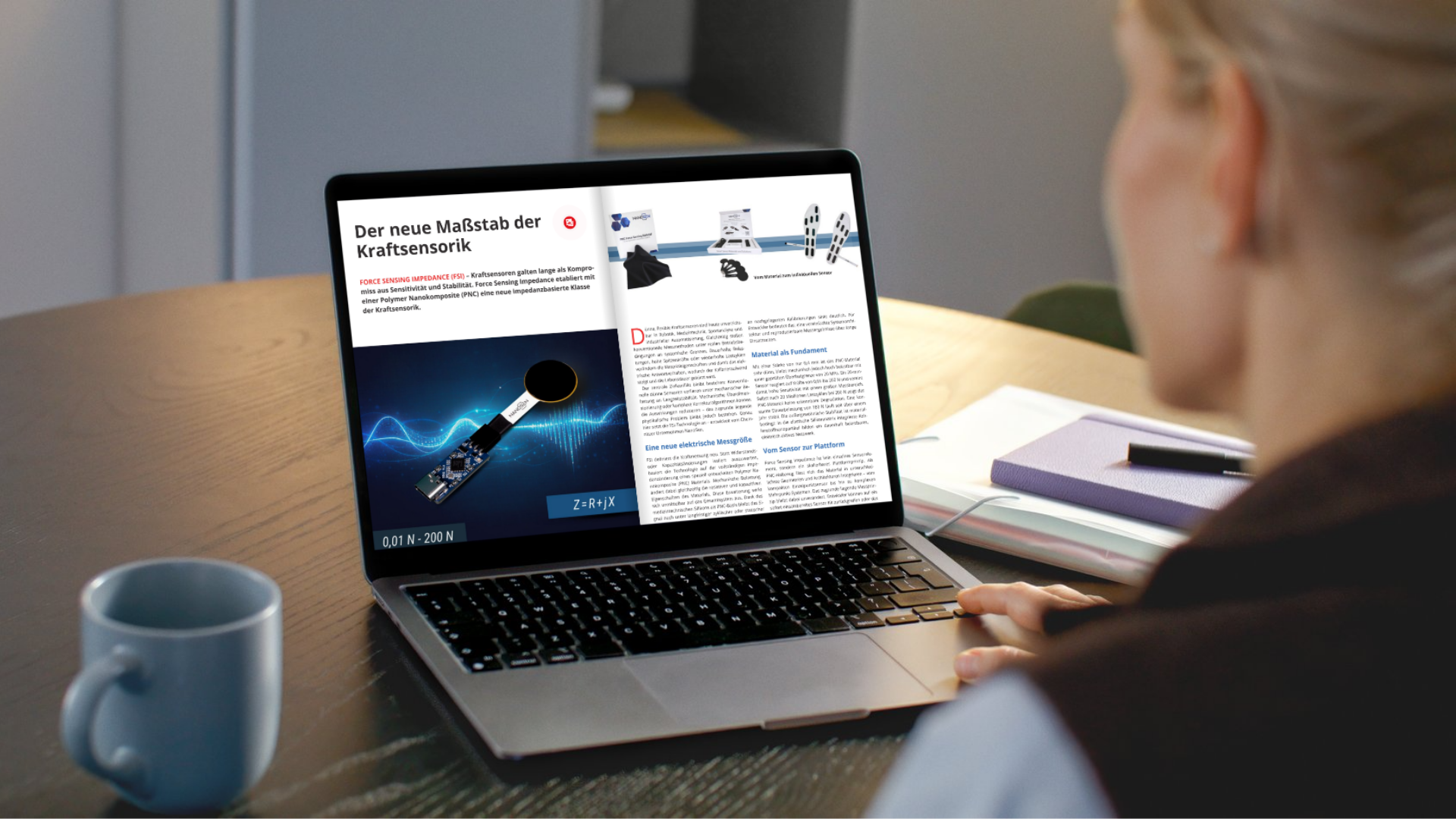
NanoSen’s Force Sensing Impedance (FSI) technology was recently featured in the SENSOR+TEST Innovationsmagazin. The article introduces a new approach to force sensing that combines polymer nanocomposite (PNC) materials with impedance-based measurement, establishing a new class of thin and flexible force sensors.
Conventional force sensing technologies often face a fundamental trade-off between high sensitivity and long-term stability. Under repeated mechanical load, high peak forces, or continuous stress, many thin-film sensors experience drift in their electrical response. As a result, recalibration becomes necessary and system reliability can decrease over time.
Force Sensing Impedance addresses these limitations by evaluating the complete impedance response of the sensing material, rather than relying solely on resistance or capacitance changes.
At the core of the technology is a PNC material in which conductive carbon nanoparticles form an electrically active network within an elastic silicone matrix. When mechanical force is applied, both the resistive and capacitive properties of the material change simultaneously. This combined response enables stable and reproducible force measurements even under long-term cyclic loads.
Despite a thickness of only 0.4 mm, the sensing material remains mechanically robust. A typical 20 mm sensor element can detect forces from 0.01 N to 200 N, while durability tests have demonstrated stable operation over 20 million load cycles.
The technology is designed as a scalable sensing platform, allowing integration into single-point sensors as well as high-resolution force distribution systems. Multi-point architectures enable real-time detection of complex load patterns, which is particularly valuable for applications in robotics, biomechanics, and industrial monitoring.
The full article provides deeper insights into the sensing principle, material platform, and application potential of Force Sensing Impedance (FSI).
Read the complete article in the SENSOR+TEST Innovationsmagazin:
German
English

No responses yet