

Customizable PNC material for force sensing applications
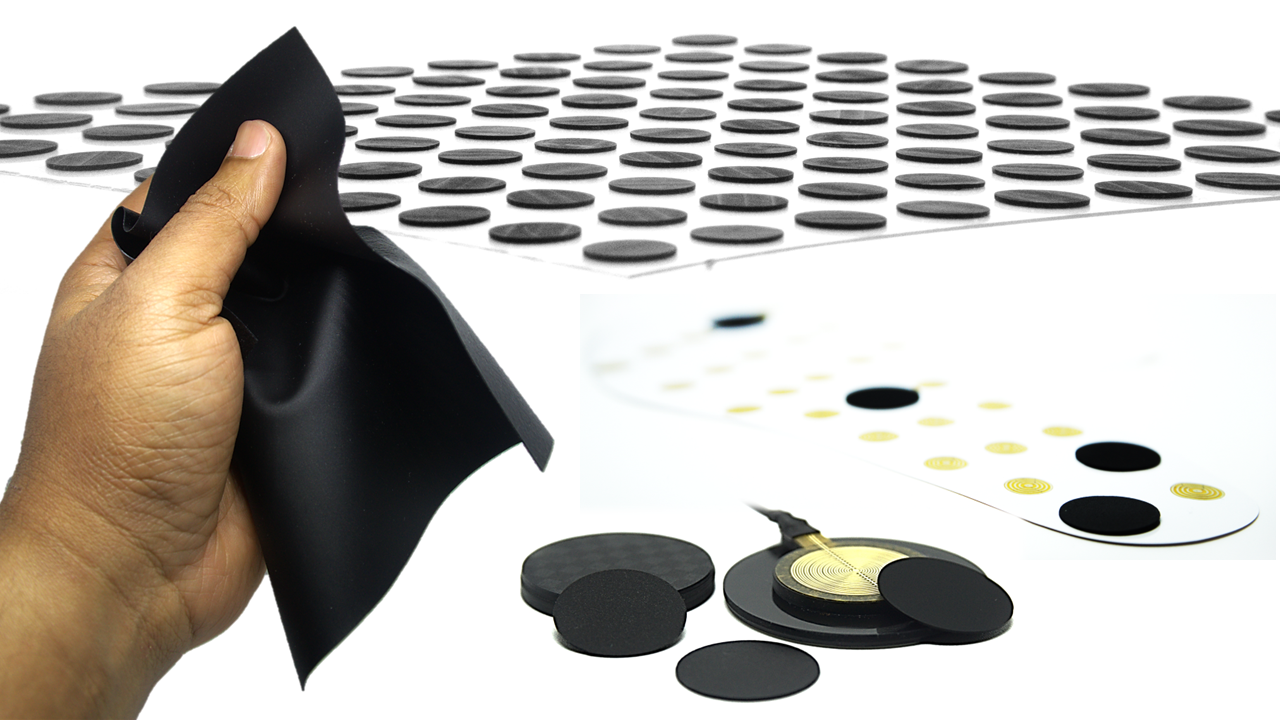
We offer our polymer nanocomposite (PNC) sensor material as an advanced force sensing material that combines polymers with functional nanomaterials.
The PNC material forms a highly sensitive and adaptable medium for force measurement and exhibits enhanced mechanical and electrical properties compared to conventional force sensing materials.
Flexibility
PNC sensor material can be processed in various shapes and sizes to meet application-specific requirements.
High sensitivity
Developed for accurate measurements even with minimal forces.
adaptability
Developed for accurate force measurements, including low-force and subtle load changes.
Durablity
Engineered for long-term use under mechanical load while maintaining performance stability.
Innovative PNC Material core
Specific advantages
The PNC material forms the core sensing element of NanoSen’s sensor systems and evaluation kits.
In combination with specially developed readout electronics, it enables stable and repeatable force measurements. The material is ROHS certified and has a REACH declaration of conformity.
Detailed insight into the performance and characteristics of the PNC material for impedance-based force measurement applications is provided in the following documentation:


Various readout methods
The PNC material supports impedance-based readout to convert mechanical force into an electrical signal.
Long-term stability
Under long-term mechanical load, the PNC material returns to its original shape without permanent deformation.
Compression in microns
The PNC material has a thickness of 0.4 mm and allows precise measurement of up to 85 µm of compression.
Overload resistance
For a sensor with a diameter of 20 mm, the PNC material saturates at 200 N and withstands overloads of up to 6200 N without material damage.
Absolute measurements
Compression of the PNC material changes its electrical conductivity.
Measured values remain stable in the compressed state without requiring a null reference point.
Temperature stability
The base material is a medical-grade elastomer.
The operating temperature range is from −20 °C to 230 °C, with no observed material degradation within this range.
